
Choosing the right filter affects system efficiency, maintenance frequency, service life, and operating costs. This guide compares wedge wire filters and perforated metal filters to help engineers, equipment manufacturers, and industrial buyers select the most suitable solution.
What Is a Wedge Wire Filter?
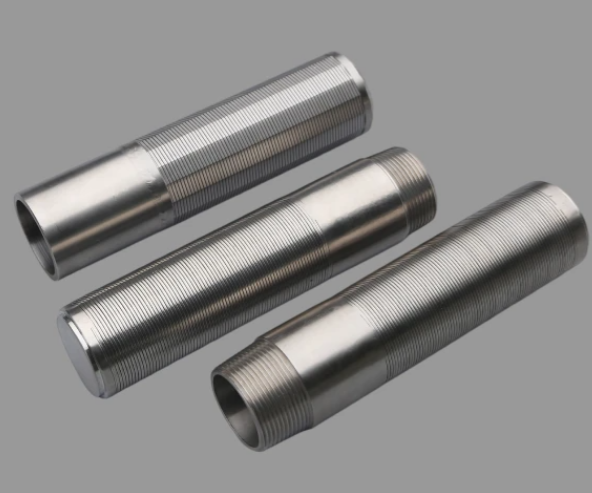
A wedge wire filter is manufactured by welding V-shaped profile wires onto support rods. The distance between adjacent profile wires creates precise and continuous filtration slots.
Its V-shaped opening is narrower at the filter surface and wider toward the inside. This structure allows particles to contact the filter at only two points, reducing the risk of blockage and making the filter easier to clean.
Wedge wire filters can be manufactured as flat panels, cylinders, baskets, screens, laterals, nozzles, resin traps, or custom filter elements. Common materials include stainless steel 304, 316, 316L, duplex stainless steel, and other corrosion-resistant alloys.
Main Advantages of Wedge Wire Filters
- Accurate and uniform slot openings
- High open area and strong flow capacity
- Excellent resistance to clogging
- Suitable for backwashing and continuous operation
- High mechanical strength and long service life
- Available in customized shapes, sizes, and slot widths
What Is a Perforated Metal Filter?
A perforated metal filter is made by punching or drilling holes into a metal sheet. The holes may be round, square, rectangular, slotted, or customized according to the screening requirements.
Perforated metal is commonly used as a protective screen, support layer, coarse filter, ventilation panel, or structural component. It offers high rigidity and can withstand impact, vibration, and heavy mechanical loads.
Common materials include stainless steel, galvanized steel, carbon steel, aluminum, copper, and nickel alloys.
Main Advantages of Perforated Metal Filters
- Simple and strong construction
- Suitable for coarse screening
- Good impact and pressure resistance
- Available in many hole patterns and sheet thicknesses
- Generally lower initial cost
- Easy to fabricate into panels, tubes, guards, and baskets
Wedge Wire Filter vs Perforated Metal Filter: Comparison Table
| Comparison Factor | Wedge Wire Filter | Perforated Metal Filter |
|---|---|---|
| Opening Type | Continuous precision slots | Punched or drilled holes |
| Filtration Accuracy | Suitable for fine and precise filtration | Better suited to coarse screening |
| Opening Consistency | Highly uniform slot width | Depends on punching and drilling tolerances |
| Open Area | Generally higher | Usually lower for comparable strength |
| Flow Capacity | High flow with lower pressure loss | Moderate flow depending on hole pattern |
| Clogging Resistance | Excellent due to V-shaped wire structure | Particles may become trapped in straight holes |
| Backwashing Performance | Excellent | Moderate |
| Mechanical Strength | High when properly designed | Very high, especially with thick metal sheets |
| Customization | Slot size, wire profile, support spacing, shape, and material | Hole size, hole shape, pattern, thickness, and material |
| Initial Cost | Usually higher | Usually lower |
| Maintenance Cost | Lower in clogging-sensitive systems | May require more frequent cleaning |
| Typical Use | Precision filtration, separation, dewatering, and screening | Coarse filtration, protection, support, and ventilation |
Which Filter Provides Better Filtration Accuracy?
Wedge wire filters generally provide better filtration accuracy. Their slots are formed by carefully controlling the spacing between adjacent profile wires. This makes it possible to produce narrow and consistent openings for solid-liquid separation.
Perforated metal filters use punched or drilled holes. While hole sizes can be controlled accurately, perforated sheets are normally more suitable for larger openings and coarse particle removal.
For applications requiring precise slot sizes, stable particle retention, or uniform product separation, wedge wire is usually the better option. For removing large debris or protecting downstream equipment, perforated metal may be sufficient.
Which Filter Has Better Flow and Clogging Resistance?
Wedge wire filters normally offer a higher open area than perforated metal filters of similar dimensions. A larger open area allows more liquid or gas to pass through the filter, helping reduce pressure drop and energy consumption.
The V-shaped profile also improves anti-clogging performance. The narrowest point is located at the filter surface, while the opening becomes wider below the surface. Particles that pass through the slot are therefore less likely to become trapped.
In comparison, perforated metal has straight holes through the sheet thickness. Irregular particles may become lodged inside these holes, particularly when the material is sticky, fibrous, or unevenly shaped.
For continuous filtration, high-flow systems, or applications with frequent backwashing, wedge wire filters usually deliver more stable performance.
Mechanical Strength and Service Life
Both filter types can provide strong mechanical performance when the material, thickness, and supporting structure are selected correctly.
Perforated metal filters are especially suitable for applications involving impact, abrasion, heavy loads, or structural support. Thick perforated sheets can protect internal filter media and prevent damage from large particles.
Wedge wire filters combine profile wires and support rods to create a rigid welded structure. They can withstand pressure, vibration, and repeated cleaning cycles. Their resistance to clogging may also extend service life by reducing localized pressure and excessive cleaning.
In corrosive environments, service life depends heavily on the selected material. Stainless steel 316L, duplex stainless steel, and corrosion-resistant alloys may be required for seawater, chemical processing, or aggressive wastewater.
Which Filter Is More Cost-Effective?
Perforated metal filters usually have a lower initial purchase cost because the manufacturing process is simpler. They are a practical choice for coarse filtration, equipment guards, support structures, and applications where highly precise openings are unnecessary.
Wedge wire filters may require a higher initial investment, but they can reduce long-term operating costs. Their higher flow capacity, lower clogging risk, easier cleaning, and longer service life can reduce downtime and maintenance requirements.
Buyers should therefore compare the total cost of ownership rather than considering only the filter price. A lower-cost filter may become more expensive if it requires frequent replacement, manual cleaning, or production shutdowns.
Typical Applications
Common Wedge Wire Filter Applications
- Water intake screening
- Wastewater treatment
- Food and beverage processing
- Brewing and sugar production
- Pulp and paper processing
- Mining and mineral separation
- Oil and gas filtration
- Petrochemical processing
- Resin and catalyst retention
- Sand control and well screens
- Rotary drum screens and static screens
- Industrial dewatering equipment
Common Perforated Metal Filter Applications
- Coarse particle screening
- Equipment protection screens
- Filter media support layers
- Ventilation and airflow panels
- Machine guards
- Industrial strainers and baskets
- Noise control panels
- Construction and architectural applications
- Food processing trays and screens
- Agricultural grading and separation
Wedge Wire Filter vs Perforated Metal Filter: Which Is Better?
Neither filter is universally better. The right choice depends on filtration accuracy, flow rate, particle characteristics, system pressure, cleaning method, and budget.
A wedge wire filter is generally better when the application requires precise separation, high flow capacity, low pressure loss, effective backwashing, or strong resistance to clogging.
A perforated metal filter is generally better when the application requires coarse screening, impact resistance, structural support, simple fabrication, or a lower initial cost.
In some filtration systems, the two materials are used together. A perforated metal layer can provide structural support or impact protection, while wedge wire performs the primary filtration function.
How to Choose the Right Industrial Filter
Before requesting a quotation, buyers should provide the following information:
- Required filtration opening: Specify the slot width, hole diameter, or target particle size.
- Filtration medium: Confirm whether the filter will handle water, oil, gas, chemicals, slurry, food products, or wastewater.
- Flow rate: Provide the required operating flow to determine the necessary filtration area.
- Operating pressure: Include normal pressure, maximum pressure, and pressure direction.
- Operating temperature: High-temperature applications may require special stainless steel or alloy materials.
- Particle characteristics: Consider particle size, shape, hardness, concentration, and whether the material is sticky or fibrous.
- Cleaning method: Confirm whether the filter will be manually cleaned, backwashed, chemically cleaned, or continuously scraped.
- Installation dimensions: Provide drawings, connection types, tolerances, and available installation space.
- Material requirements: Select the material according to corrosion resistance, food-grade requirements, and mechanical strength.
Supplying complete operating information allows the manufacturer to recommend the appropriate filter structure, opening size, material, thickness, and support design.
Frequently Asked Questions
1. Can wedge wire filters replace perforated metal filters?
Yes, in many filtration applications. However, replacement depends on the required strength, filtration accuracy, installation method, and operating conditions. Wedge wire is often selected when improved flow and clogging resistance are required.
2. Can perforated metal support a wedge wire filter?
Yes. Perforated metal can be used as a reinforcing or protective layer in multi-layer filter assemblies. This combination provides mechanical strength while maintaining precise filtration performance.
3. Which filter is easier to clean?
Wedge wire filters are generally easier to clean because their V-shaped slots reduce particle trapping. They are particularly suitable for backwashing, scraping, and continuous cleaning systems.
4. Which filter is suitable for fine filtration?
Wedge wire filters are usually more suitable for fine and consistent filtration. Perforated metal is mainly used for larger particles, coarse screening, or as a support layer for finer filter media.
5. Can both filters be customized?
Yes. Wedge wire filters can be customized by slot size, profile wire, support rod, diameter, shape, length, and material. Perforated metal filters can be customized by hole size, pattern, open area, sheet thickness, shape, and material.
Conclusion
Wedge wire filters provide precise openings, high flow capacity, strong anti-clogging performance, and efficient backwashing. They are ideal for demanding industrial filtration, separation, and dewatering applications.
Perforated metal filters provide excellent rigidity, impact resistance, simple construction, and cost-effective coarse screening. They are well suited to protective, structural, and pre-filtration applications.
The best choice should be based on filtration accuracy, operating conditions, maintenance requirements, and total lifecycle cost. For complex applications, buyers should consult an experienced filter manufacturer and provide complete technical specifications before selecting a filter.


